The International Society of Vibrational Medicine & Radionics
Our Blog
Are We Moving Closer to Accepting Frequency and Quantum Approaches to Healing?
Are We Moving Closer to Accepting Frequency and Quantum Approaches to Healing?
A Changing Paradigm in Health, Science and Integrative Medicine
Medicine has never remained static. Our understanding of the human body has developed through observation, experimentation, technological progress and the courage to question established ideas. Many medical possibilities that once appeared unrealistic have gradually become part of standard healthcare, while other theories have failed to withstand scientific investigation.
Today, we appear to be entering another period of significant change. Advances in regenerative medicine, neuroscience, bioengineering, bioelectromagnetics, artificial intelligence and quantum technologies are expanding the way we understand biological processes. At the same time, traditional, complementary and integrative approaches are receiving renewed attention from researchers, practitioners, patients and international organisations.
The World Health Organization’s Global Traditional Medicine Strategy 2025–2034 reflects this changing climate. It calls for stronger evidence, improved regulation, greater safety and the responsible integration of traditional, complementary and integrative medicine into healthcare systems where appropriate. [1]
This raises an important question: are we becoming more prepared to investigate frequency-based, energetic, informational and quantum-inspired approaches to health and healing?
I believe the answer is yes, but this acceptance must develop through research, collaboration and responsible communication. Openness to new ideas should not mean accepting every claim without evidence. Equally, scientific caution should not become a reason to reject unconventional possibilities before they have been properly explored.
The Human Being Is More Than a Biochemical Machine
Modern medicine has achieved extraordinary results through the study of biochemistry, anatomy, genetics, microbiology and pathology. Nevertheless, the human body is not governed only by chemical substances.
Every heartbeat depends upon electrical activity. Nerve cells communicate through electrochemical impulses. Muscle contraction relies on electrical signalling. Cell membranes maintain electrical potentials that regulate the movement of ions and influence cellular behaviour.
Medicine already uses these principles every day. Electrocardiography measures the electrical activity of the heart, while electroencephalography records electrical patterns in the brain. Pacemakers, cochlear implants, deep-brain stimulation and vagus-nerve stimulation use electrical signals to influence physiological function. Magnetic fields, sound waves and light are also applied in medical diagnosis and treatment.
Research in bioelectricity is showing that electrical patterns may contribute to embryonic development, wound healing, tissue organisation and regeneration. Cells do not behave as isolated units. They communicate continuously and participate in wider networks that help the body maintain order, adaptation and repair. [2–5]
This does not prove every theory about energetic healing. It does, however, demonstrate that energy, electrical signalling and biological information are genuine aspects of life. The separation between the physical body and its energetic organisation may therefore be less absolute than older medical models have assumed.
Energetics and Subtle Anatomy
For thousands of years, healing systems from different cultures have described the human being as possessing both a physical body and a more subtle organisation of energy.
Traditional Chinese medicine describes the movement of qi through meridians. Indian philosophy and Ayurveda refer to prana, chakras and subtle channels known as nadis. Other traditions describe an aura, vital field or life force that surrounds and interpenetrates the physical body.
These systems developed long before modern anatomy, neurobiology or electromagnetic measurement. Their terminology should not be presented as though it were identical to contemporary scientific language. Chakras are not recognised as anatomical organs, and meridians have not been established as physical structures in the same way as nerves or blood vessels.
Nevertheless, these models represent long-standing attempts to understand relationships between bodily function, emotions, consciousness, vitality and health.
In practical energetic traditions, subtle anatomy is often understood as a bridge between physical, emotional, mental and spiritual aspects of the human being. An imbalance may be perceived first within the energetic system before becoming expressed through emotional distress, loss of vitality or physical symptoms.
This concept is central to radionics, energy medicine and many complementary approaches. Rather than viewing illness only as a localised physical defect, these traditions consider whether the person’s wider energetic organisation, emotional condition, environment and patterns of adaptation may also be involved.
Scientific investigation of subtle anatomy remains challenging because the concepts are not always precisely defined or easily measured. Yet difficulty of measurement does not necessarily mean that the subject should be ignored. It means that clearer hypotheses, better instruments and more rigorous research methods are needed.
The task is not to force ancient energetic concepts into modern scientific terminology. It is to explore carefully whether any measurable physiological, bioelectrical, electromagnetic or informational processes may correspond with experiences traditionally described through subtle anatomy.
From Treating Disease to Understanding the Whole Person
For much of the twentieth century, healthcare developed through a reductionist approach. A disease was identified, its mechanism was investigated and a particular intervention was used to target the pathology.
This model has saved countless lives and remains essential. Surgery, pharmaceuticals, emergency medicine, vaccination, infection control and advanced diagnostic technologies are among the greatest achievements of modern healthcare.
However, chronic disease, mental-health difficulties, autoimmune conditions and stress-related disorders do not always fit neatly into a single-cause model. Human health is shaped by many interacting factors, including genetics, immunity, inflammation, nutrition, sleep, environment, behaviour, relationships, emotional experience and social circumstances.
Modern systems biology is beginning to study these interactions as networks rather than isolated parts. Personalised and precision medicine recognise that two people with the same diagnosis may have different biological characteristics and may respond differently to the same treatment.
This change reflects a broader transformation in the meaning of healthcare. We are gradually moving from treating disease alone towards understanding the person who is experiencing it. We are moving from isolated organs towards interconnected systems, from standardised interventions towards more personalised care, and from symptom suppression towards prevention, resilience and regulation.
I do not believe this requires rejecting conventional medicine. It requires expanding our understanding of what contributes to illness and what supports healing.
Bioelectromagnetics and Frequency-Based Medicine
Bioelectromagnetics studies the interactions between electromagnetic phenomena and living systems. It brings together biology, medicine, physics and engineering and includes both naturally occurring biological fields and externally applied electrical or electromagnetic stimulation. [6]
Frequency-based principles are already used in recognised medical technologies. Ultrasound uses sound frequencies for imaging and treatment. Electrical stimulation is used in pain management, neuromodulation and rehabilitation. Certain electromagnetic technologies are used in diagnostic imaging and therapeutic applications. Light-based therapies are also used in dermatology and other areas of medicine.
Researchers continue to investigate how electrical stimulation may influence cell migration, circulation, wound repair and tissue regeneration. The effects depend upon the type of energy, strength, frequency, duration, method of delivery and biological target. [3,4]
The term frequency medicine, however, is used very broadly. It can refer to recognised clinical technologies, experimental devices, complementary therapies and approaches that remain largely theoretical.
This is why precise language matters. A treatment does not become effective simply because it uses a frequency. The frequency, intensity, exposure, mechanism and measurable biological effects must all be defined.
At the same time, it would be equally inaccurate to suggest that using frequencies in medicine is inherently unscientific. Modern healthcare already uses sound, light, electricity and electromagnetic fields. The real scientific question is not whether frequencies can affect biology, but which frequencies, delivered in which way, may produce safe, reliable and clinically meaningful effects.
Quantum Biology and Quantum Healing
Quantum biology is an established interdisciplinary field that investigates whether quantum-mechanical phenomena contribute to particular biological processes.
Research has explored possible quantum effects in photosynthesis, enzyme reactions, electron and proton transfer, olfaction and the magnetic orientation of animals. Quantum technologies may also contribute to increasingly sensitive biological measurement, imaging and medical sensing. [7–10]
These developments demonstrate that the relationship between quantum physics and biology is not purely imaginary. However, they do not prove every claim associated with the phrase quantum healing.
In public and commercial language, quantum healing can describe very different practices. It may refer to meditation, consciousness, energy therapies, frequency instruments or products using quantum terminology without demonstrating a clear relationship to quantum physics.
For this reason, I believe we must differentiate carefully between quantum biology, quantum technologies, quantum-inspired healing philosophies and commercial claims.
The discovery of quantum phenomena in biological systems does not automatically validate a particular device or healing method. Every technology must be evaluated according to its own evidence, safety and results.
Nevertheless, quantum biology is important because it challenges the older view of the body as a simple mechanical structure. It reveals that life may depend upon processes that are far more complex, interconnected and sensitive than previously understood.
Japan and the Future of Medical Innovation
Japan is often associated with futuristic medicine because of its achievements in robotics, precision engineering, medical-device development and regenerative medicine.
The country has created regulatory pathways for regenerative medical products and advanced therapies. The Pharmaceuticals and Medical Devices Agency evaluates medical technologies according to their classification, quality, safety, risk and supporting evidence. [11,12]
This makes Japan an important example of how innovation can be encouraged while still remaining subject to scientific and regulatory assessment.
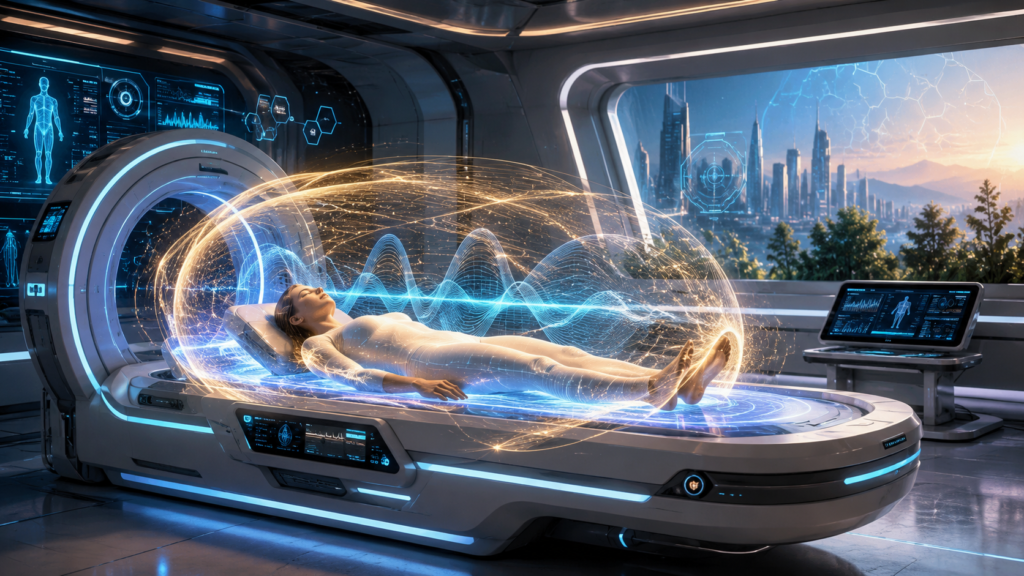
Recent online discussions have claimed that Japan has approved futuristic “MedBeds” using quantum or frequency healing. At present, these specific claims have not been confirmed through publicly available information from the Japanese regulatory authorities.
Advanced hospital beds, regenerative treatment systems and robotic medical platforms should not automatically be described as quantum MedBeds. The real advances taking place in Japan are already impressive and do not need to be exaggerated.
The important message is that medicine is moving towards technologies that once appeared futuristic. Regenerative therapies, intelligent hospital systems, precision diagnostics and personalised medical technologies are developing rapidly. The concept of a future healing platform that combines advanced scanning, biological data, AI, regenerative therapies and carefully controlled energetic stimulation may therefore not be entirely impossible.
However, imagination must remain connected to evidence. The future should inspire research, not encourage unsupported medical promises.
A Century of Radionics
The exploration of frequency, resonance and biological information did not begin with contemporary quantum terminology.
During the twentieth century, doctors, chiropractors, engineers, inventors and researchers developed the field that became known as radionics.
The history of radionics is generally traced to the American physician Dr Albert Abrams, who developed the controversial Electronic Reactions of Abrams. He proposed that diseases could be associated with characteristic responses or rates. His work was strongly criticised by the medical establishment, yet it influenced later generations of radionic researchers.
Dr Ruth Drown expanded these ideas by developing her own instruments and systems of numerical rates. She explored the use of biological samples, often referred to as witnesses, and the possibility of assessment and treatment at a distance.
In Britain, the civil engineer George de la Warr, working with Marjorie de la Warr, developed new radionic instruments and established laboratories for experimental research. Their work helped make Britain an important centre for radionics during the middle of the twentieth century.
Dr Bruce Copen later became one of the most influential figures in modern radionics. He was associated with the development of radionic instruments, electronic homeopathy, colour and frequency devices and eventually computer-assisted systems. Through his books, instruments and international work, he contributed greatly to the spread and modernisation of radionics. [13]
Dr David Tansley, a chiropractor, naturopath and author, introduced a broader understanding of radionics based on subtle anatomy. His work explored the relationship between the chakras, energetic fields and the physical body. He presented human health as a multidimensional process involving physical, emotional, mental and subtle levels. His books include Radionics and the Subtle Anatomy of Man, Dimensions of Radionics and Chakras, Rays and Radionics. [14,15]
Other important contributors, including Malcolm Rae, Aubrey Westlake, Guyon Richards and Darrell Butcher, continued developing radionic instruments, geometric principles and theoretical models.
The history of radionics should be presented honestly. Its proposed non-local and subtle-energy mechanisms have not been accepted by mainstream biomedical science. This does not erase its historical importance, nor does it mean that every observation made by radionic practitioners is without value.
It means that radionics requires serious documentation, clearer research questions and appropriately designed studies.
The Body as a System of Information
Living organisms depend upon the exchange and interpretation of information.
DNA carries biological instructions, but genes do not operate independently. Their activity is influenced by signals from the cell and its environment. Cells communicate through chemical, electrical and mechanical pathways. The nervous system, endocrine system and immune system exchange continuous messages.
Biological health therefore depends not only upon the substances present in the body, but also upon timing, sequence, organisation and communication.
This offers a possible bridge between modern systems biology and the broader concept of information medicine.
Information medicine proposes that health may be influenced by correcting patterns of biological organisation and communication, not only by introducing chemical substances. Some recognised medical technologies, such as neuromodulation, already influence biological information through controlled electrical signals.
More speculative approaches propose that subtle or non-local information may also affect living systems. These ideas remain scientifically unresolved and should not be presented as established facts.
Nevertheless, the concept deserves investigation. If a therapeutic system claims to transmit information, research should ask what form that information takes, how it is encoded, how it is detected and whether it produces a consistent biological effect.
Collaboration, Not Competition
I strongly believe that the future of healthcare should not be built upon conflict between conventional and complementary medicine.
Conventional medicine provides essential diagnosis, emergency treatment, surgery, pharmacology and evidence-based clinical care. Complementary approaches may contribute perspectives on prevention, lifestyle, emotional wellbeing, the therapeutic relationship, self-regulation and the wider experience of the individual.
Neither side possesses every answer.
The most valuable progress may emerge when doctors, scientists, engineers, psychologists, holistic practitioners, researchers, regulators and patients begin working together.
Practitioners can bring forward observations and clinical questions. Scientists can help transform those observations into testable hypotheses. Engineers can improve instruments and measurement. Statisticians can strengthen study design. Healthcare professionals can ensure that safety and clinical responsibility remain central.
Collaboration does not mean that every theory must be accepted. It means creating an environment in which ideas can be examined respectfully and critically.
A new healthcare paradigm should not ask us to choose between science and holistic healing. It should encourage us to develop better science capable of studying the human being more completely.
A New Paradigm of Health and Healing
The future of medicine may not be defined by one machine, one discovery or one healing philosophy.
It may emerge from a deeper recognition that the human being is simultaneously physical, biological, emotional, mental, social, electrical and informational.
For some people, spiritual and energetic dimensions are also essential parts of the experience of health. These dimensions may not always be measurable through present scientific methods, but they influence how people understand themselves, illness, recovery and meaning.
A more complete healthcare model would continue to use established diagnosis and treatment while placing greater attention on prevention, emotional health, personalised care, patient participation, lifestyle, environment, biological regulation and resilience.
It would not replace evidence with belief. Nor would it assume that the absence of current evidence is proof that no phenomenon exists.
Instead, it would create space for curiosity, critical thinking and responsible investigation.
Looking Towards the Future
Frequency medicine, quantum biology, bioelectromagnetics, regenerative medicine, energy healing and radionics do not currently have the same level of scientific evidence. They should not be merged into one category or promoted as though they were equally established.
Some already have recognised clinical applications. Others are developing scientific fields. Some remain theoretical, experiential or controversial.
I believe progress will come from acknowledging these differences while continuing to investigate areas where meaningful questions remain unanswered.
The International Society of Vibrational Medicine & Radionics supports a future founded upon responsible research, education, ethical practice and interdisciplinary collaboration.
We welcome scientists, researchers, healthcare professionals, psychologists, engineers, educators, holistic practitioners, laboratories and developers of radionics and frequency technologies who share an interest in advancing knowledge and encouraging responsible innovation.
The future of healthcare may not require us to choose between conventional medicine and complementary approaches. It may require us to bring together valid knowledge from many disciplines and create a broader, more personalised and more humane understanding of health.
The real change of paradigm begins when we stop seeing healing as the elimination of a symptom alone and begin to understand it as the restoration of communication, regulation, coherence and balance within the whole person.
References
World Health Organization. Global Traditional Medicine Strategy 2025–2034. Geneva: World Health Organization; 2025.
McLaughlin KA, Levin M. Bioelectric signalling in regeneration: mechanisms of ionic controls of growth and form. Developmental Biology. 2018;433(2):177–189.
Zhao M, et al. Role of bioelectricity in directional cell migration in wound healing. International Journal of Molecular Sciences. 2022;23(19):11493.
Preetam S, et al. Electrical stimulation as a therapeutic strategy to support wound healing and tissue regeneration. International Journal of Surgery. 2024.
Levin M. Bioelectric signalling: reprogrammable circuits underlying embryogenesis, regeneration and cancer. Cell. 2021;184(8):1971–1989.
BioEM Society. Bioelectromagnetics and Biological Interactions with Electromagnetic Fields. BioEM Society.
Marais A, et al. The future of quantum biology. Journal of the Royal Society Interface. 2018;15(148):20180640.
Cao J, et al. Quantum biology revisited. Science Advances. 2020;6(14):eaaz4888.
Brookes JC. Quantum effects in biology: golden rule in enzymes, olfaction, photosynthesis and magnetodetection. Proceedings of the Royal Society A. 2017;473(2201):20160822.
National Academies of Sciences, Engineering, and Medicine. Quantum Science Concepts in Enhancing Sensing and Imaging Technologies: Applications for Biology. Washington, DC: National Academies Press; 2021.
Pharmaceuticals and Medical Devices Agency. Regenerative Medical Products. Tokyo: PMDA.
Pharmaceuticals and Medical Devices Agency. Regulations and Approval or Certification of Medical Devices. Tokyo: PMDA.
Bruce Copen Laboratories. Bruce Copen and the Development of Copen Radionic Instruments. CopenLabs.
Tansley DV. Radionics and the Subtle Anatomy of Man. London: C.W. Daniel Company; 1972.
Tansley DV, Rae M. Dimensions of Radionics: A Manual of Radionic Theory and Practice for the Health-Care Professional. Saffron Walden: C.W. Daniel Company; 1977.
Important Notice
This article is intended for education, historical discussion and the exploration of emerging research. It does not claim that radionics, energy healing, quantum-healing devices or unverified “MedBed” technologies can diagnose, treat or cure medical conditions. Complementary approaches should not replace appropriate medical assessment or evidence-based treatment.